
FIP in Cats: How a Once-Fatal Disease Became Treatable
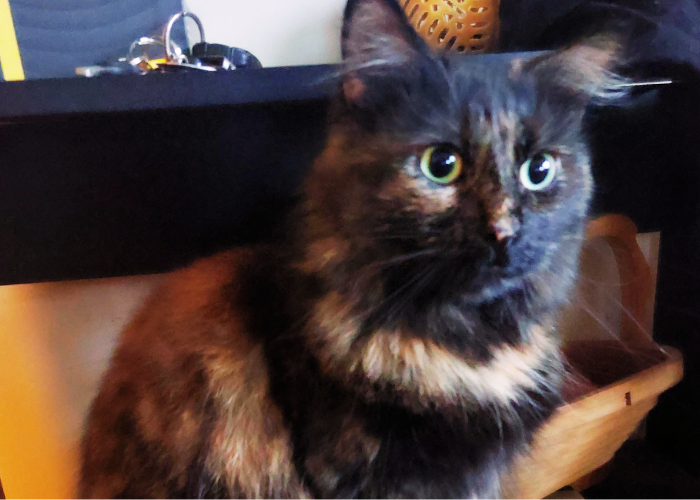
Spooky and her story
By Stephanie Garcia-Gonzalez, RVT, Board Member, Sage Compassion for Animals
In the early 2000s, my family brought home a beautiful long-haired tortoiseshell kitten with patches of orange and black. We named her Spooky. She was playful, affectionate, endlessly loving, and quickly became part of our family. Although I was fortunate to grow up surrounded by many wonderful pets, Spooky has always held a special place in my heart.
When she was less than a year old, we noticed something wasn't right. She became lethargic, stopped eating, and even began urinating outside of her litter box, all behaviors that were completely unlike her. We brought her to the veterinary hospital hoping there would be a treatment that would make her better.
Instead, we learned she had Feline Infectious Peritonitis, or FIP.
At the time, I didn't fully understand what FIP was. I only knew what it meant: there was nothing anyone could do.
Today, we know much more about FIP in cats, including what causes it, how it can affect young cats, and most importantly, how advances in veterinary medicine have changed the outlook for cats diagnosed with this disease.
What Is FIP in Cats?
Feline Infectious Peritonitis (FIP) is a serious disease that develops when feline coronavirus mutates inside a cat's body and triggers an abnormal inflammatory response.
Feline coronavirus itself is very common. Many cats are exposed to feline coronavirus during their lifetime and never become seriously ill. In a small percentage of cats, most commonly kittens and young cats, the virus can mutate and lead to FIP.
FIP can affect different parts of the body, which means FIP symptoms in cats can vary significantly. Depending on the form of the disease, cats may experience symptoms such as:
Lethargy
Loss of appetite
Weight loss
Fever
Abdominal swelling
Difficulty breathing
Changes in behavior or overall health
Because cats are very good at hiding illness, changes that seem subtle can sometimes be the first indication that something is wrong.
If you're noticing changes in your cat's behavior, appetite, litter box habits, or overall health, it's important to talk with your veterinarian. Our guide,Emergency Vet or “Let’s Wait and See”? How to Know What Your Pet Needs, can help you recognize situations that may require more immediate veterinary attention.
When FIP Was Considered a Fatal Diagnosis
When Spooky became sick more than 20 years ago, FIP was considered a devastating diagnosis in veterinary medicine.
There were no medications that could stop the disease. Treatment focused only on supportive care, helping cats remain comfortable through pain management, nutritional support, and other measures to ease their symptoms.
While these treatments could sometimes improve a cat's quality of life for a short period, they could not stop the disease from progressing. For nearly every family, an FIP diagnosis ultimately ended with the heartbreaking decision to euthanize their beloved companion to prevent further suffering.
That was Spooky's reality.
I still remember the helplessness of sitting in the exam room and realizing that no one, not my family and not the veterinary team had the ability to save her. She was less than a year old. Her life had barely begun.
What I remember most, though, isn't her illness.
I remember how loving Spooky remained. Even as she became weaker, she still wanted to be close to us. She still purred. She still sought affection. Animals have an incredible capacity to love us through their own pain, asking for so little in return. They trust us completely, and they deserve our very best in return.
A Personal Loss That Led to a Career in Veterinary Medicine
Losing Spooky changed me.
Along with many of the incredible animals I've been fortunate enough to love throughout my life, she inspired my decision to pursue a career in veterinary medicine. I wanted to dedicate my life to helping animals and supporting the people who love them through both joyful and heartbreaking moments.
That passion eventually led me to become a Registered Veterinary Technician and later to serve on the Board of Sage Compassion for Animals, where we work to improve access to veterinary care and strengthen the bond between people and their pets.
As a Registered Veterinary Technician, I have since sat beside many families hearing the same devastating diagnosis. I understood the shock, the fear, and the overwhelming sense of helplessness because I had lived it myself.
While my colleagues and I did everything we could to support those families through one of the most difficult moments of their lives, knowing there was no cure made those conversations especially heavy.
Then something extraordinary happened.
FIP Treatment: From Fatal Diagnosis to Hope
Years of dedicated veterinary research led to the development of antiviral medications for FIP that directly target the virus responsible for the disease.
What had once been considered an almost universally fatal disease suddenly became treatable.
Today, with early diagnosis, appropriate antiviral therapy, and veterinary monitoring, many cats diagnosed with FIP can recover and go on to live healthy lives.
One of the greatest tragedies in feline medicine has become one of its greatest success stories.
I cannot fully express the gratitude I feel knowing that this treatment now exists. Every time I hear about another kitten surviving FIP, I think of Spooky.
While her story cannot be rewritten, I find comfort in knowing that countless other cats and families may never have to experience the same heartbreak that my family, and so many others endured.
Can Cats Recover From FIP?
Yes. The development of effective antiviral treatment has dramatically changed the outlook for cats with FIP.
FIP treatment should always be guided by a veterinarian, and the appropriate treatment plan depends on the individual cat, the form of FIP, and other health considerations.
If your cat has been diagnosed with FIP, ask your veterinary team about available treatment options and what monitoring your cat will need throughout treatment.
It is also important to remember that FIP diagnosis and treatment can be complicated. There is not always a single test that provides a simple answer, and veterinarians may need to consider a cat's symptoms, history, examination findings, laboratory results, and other diagnostic information.
Frequently Asked Questions About FIP in Cats
Is FIP fatal in cats?
FIP was once considered almost universally fatal. Advances in antiviral treatment have dramatically changed the outlook, and many cats diagnosed with FIP can now recover with appropriate treatment.
Can cats recover from FIP?
Yes. With appropriate antiviral treatment and veterinary monitoring, many cats diagnosed with FIP can recover and go on to live healthy lives.
What causes FIP in cats?
FIP develops when feline coronavirus mutates within a cat's body and triggers an abnormal inflammatory response. Feline coronavirus is common, but only a small percentage of infected cats develop FIP.
What are the signs of FIP in cats?
Signs can vary depending on the form of FIP and the parts of the body affected. Possible symptoms include lethargy, loss of appetite, weight loss, fever, abdominal swelling, breathing difficulties, and other changes in health or behavior.
If your cat is showing concerning symptoms, contact your veterinarian for guidance.
Why Veterinary Research Matters
To me, this breakthrough is about so much more than a new medication.
It is proof of what is possible when researchers, veterinarians, and advocates refuse to accept that a disease is untreatable.
It reminds us that every advancement in veterinary medicine begins with curiosity, compassion, and the determination to do better for the animals who depend on us.
FIP is a powerful example of how dramatically veterinary medicine can change. A diagnosis that once meant almost certain loss can now come with something families desperately needed: hope.
Education, Hope, and the Future of FIP
At Sage Compassion for Animals, we believe education is one of the most powerful ways to improve the lives of pets and the people who love them. Learning about advances in veterinary medicine can give families hope and help them have more informed conversations with their veterinary teams.
To me, FIP is a powerful reminder of what is possible when researchers, veterinarians, and advocates refuse to accept that a disease is untreatable. It shows how curiosity, compassion, and determination can change the lives of animals and the families who love them.
Spooky's story ended far too soon.
Because of the remarkable work of researchers, veterinarians, and advocates around the world, it doesn't have to end that way for today's cats. That gives me hope and pride for our veterinary profession, and it is one of the many reasons I am proud to support the mission of Sage Compassion for Animals.
For Spooky, the treatment came too late. For today's cats, FIP can mean hope.